
Into the great plains: A thunderous transition
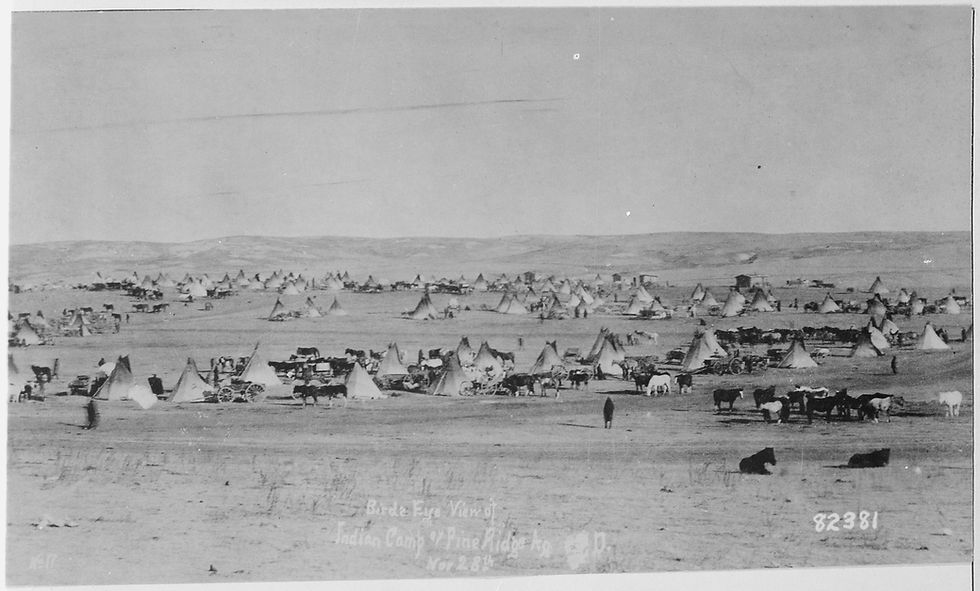
Combining their ancestral woodland resilience with these new arrivals, the Lakota adapted at an unimaginable pace. Within a 70-year window, they transformed from semi-sedentary woodland farmers to the undisputed masters of the Great Plains. The vast oceans of grass, once too expansive to traverse on foot, became their new, boundless domain. At the peak of their dominance, the Lakota civilization was a vibrant, highly mobile society, perfectly in step with the rhythms of the Buffalo.
Šuŋkawakȟaŋ: The Sacred Dog and the Equestrian Revolution
Though the Lakota were not strangers to the edges of the plains, the true blaze west required a fire-starter. When southern bands of the Lakota first encountered horses around 1700, the animals were immediately revered as sacred allies. Drawing on their ancient reliance on canine companions, the Lakota named the horse Šuŋkawakȟaŋ (Sacred Dog).
The horse revolutionized Lakota mobility and engineering. For generations, women had packed small dog-drawn travois to move camp. With the arrival of the horse, these travois could be built significantly larger to carry heavier loads, young children, and elders. This newfound hauling power meant that tipis could become much larger and more spacious, completely transforming village life. To support this lifestyle, the Lakota engineered resilient saddles by binding wood and elk horn with raw, un-tanned bison hide, which shrank as it dried to create a frame so strong it could be passed down for generations.But the most profound transformation occurred in hunting and warfare. The Lakota became unparalleled equestrians, developing tactics that made them the most formidable force in the West. In combat, a Lakota warrior could place a loop of braided horsehair around the horse's neck. Dropping down to hang against the side of the galloping horse, the warrior was completely shielded from enemy view by the animal's body. From beneath the horse's neck, they could unleash a terrifying volley of arrows. A skilled Lakota archer on horseback could fire a dozen arrows with lethal precision in the time it took an early frontiersman or rival to reload his single-shot musket.
Milestones of Manhood: The First Horse and the First Kill
This equestrian mastery was woven deeply into the upbringing of Lakota youth. As immortalized in accounts like Black Elk Speaks, learning to ride was a highly anticipated rite of passage. Boys learned to ride almost as soon as they could walk, and breaking their first pony was a celebrated milestone that marked their transition out of childhood. Earning the right to ride alongside the men was the ultimate goal.Bamm Brewer, head of the Charging Buffalo House, explains how this eagerness culminated in the "first kill" custom, a rite of passage where a boy officially became a man capable of providing for his people."A long time ago, the story goes that the young boys, whenever the warriors left the camp, the women would watch the boys," Bamm explains. "They would stay around camp because they were too small... And then there was a day that came when the young boy was big enough to come with the warriors... They were horse holders and they were helpers... And then whenever they returned to the camp, the women honored them because they knew that now they're going to become men".It is important to note that while the core reverence for life is universally shared across the Lakota, specific customs and rites vary deeply by family and society. For instance, after a successful harvest, Bamm’s family preserves a rare, ancient society tradition: the young warrior takes a bite of raw buffalo liver coated in the animal's bile. Because bile contains natural antimicrobial properties, this highly specific family custom serves to physically and spiritually purify the hunter using the very same elements the buffalo uses to purify itself.
The Accelerated Cycle: Following the Herd
With the horse as their vehicle, the massive, migratory buffalo herds became the beating heart of Lakota existence. In the woodlands, the Lakota moved to the deliberate, predictable rhythm of sap rising, squash growing, and wild rice ripening. On the plains, however, their life-cycle accelerated dramatically.The seasons were no longer dictated by stationary plants, but by the unpredictable, thundering migrations of the buffalo. The horse allowed the Lakota to strike camp quickly, pack their massive tipis, and follow the herds across the vast ocean of grass. With agriculture largely left behind, hunting expanded into the central role of sustaining their people.Because of this intense reliance, the buffalo provided everything. The heavy hides became warm winter robes and waterproof tipi covers. The hair was braided together with horsehair to form incredibly strong ropes. Absolutely nothing was wasted; even the stomachs and intestines were carefully cleaned and utilized as nutrient-dense food.
Life on the Plains: Mitákuye Oyás'iŋ
Yet, despite their fearsome reputation and total dominance of the region, hunting was never a sport—it was a deeply ceremonial occasion.Every animal was sacred, and hunting wasn’t about killing needlessly; it was a sacrifice required for survival. The Lakota worldview did not place humans at the top of a hierarchy meant to dominate nature. Instead, their lives were rooted in the philosophy of Mitákuye Oyás'iŋ (We are all related). They recognized that they shared the same sacred energy (wakhán) with the buffalo, the horse, and the plains themselves.
The Cullings and the First Reservations
This vibrant, symbiotic way of life was abruptly threatened as European settlers expanded westward. The United States government and military quickly realized that they could not defeat the Lakota in fair combat. Instead, they targeted the center of Lakota life: the buffalo. In a deliberate and devastating military tactic, millions of buffalo were slaughtered by settlers and left to rot on the plains. The goal was to starve the plains tribes into submission, destroying the ecological foundation that made their independence possible. This era was marked by intense Lakota wars and a long ledger of broken treaties, ultimately forcing the Lakota off the open plains and onto confined reservations.

The Unbroken Circle
The cullings were designed to erase the Lakota way of life entirely. But the Lakota possess a profound capacity for resilience and adaptation. They did not disappear. The circle was never broken. Today, community leaders on the Pine Ridge Reservation are actively healing that history by bringing the buffalo back to the people.

"Everything that Crazy Horse fought and died for was the Buffalo way of life, the old way," Bamm Brewer explains. "If we don't try to do that, the Buffalo way of life, then everything he died and fought for was for nothing... So we're just doing what Crazy Horse wanted, and for our people, it's trying to bring back the Buffalo culture".
By turning reservation lands back into buffalo pastures, processing the meat for the community, and teaching young Lakota men sacred hunting traditions, leaders like Bamm are ensuring the sacred bond remains intact.


